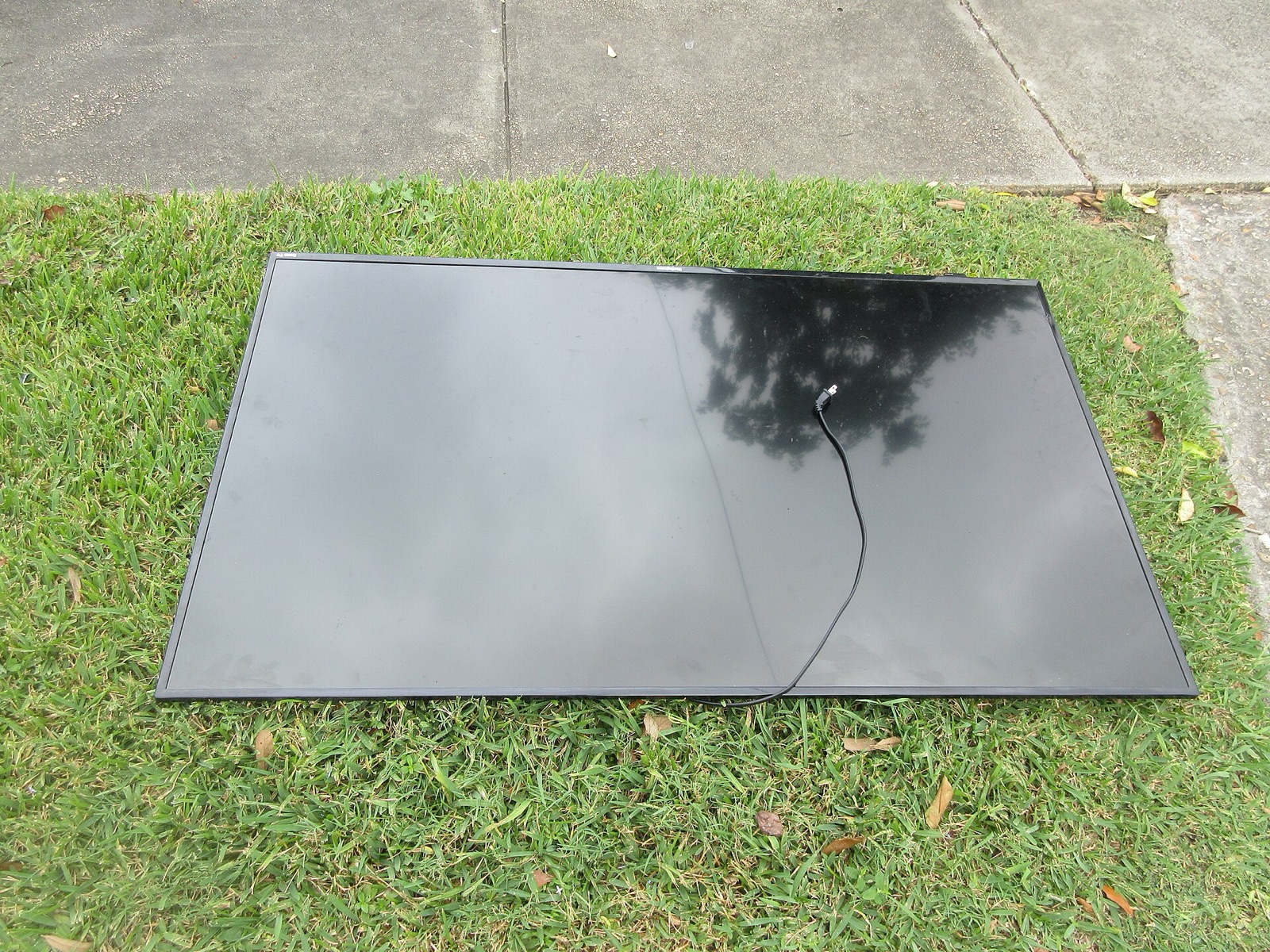

If the TV works, sell it or give it away. If not, take it to a city, county or state program drop-off site, which is often free. Best Buy takes most TVs up to 50 inches for $29.99. Pay for pickup only if you can’t move it. Don’t leave a TV at the curb unless your city allows it.
Your options, from cheapest to last resort
Start at the top of this list. Stop at the first option that works for your TV and where you live. Costs and rules change from city to city, so check your local guide before you load the car.
| Option | Usual cost to you | Best for | Check first |
|---|---|---|---|
| Sell it or give it away | Free, and you may get some money | Working flat screens | Most buyers and charities don’t want tube TVs |
| State program drop-off site | Free in states such as Washington, Oregon, Vermont and Connecticut | Any TV in a state with a program | Item limits, who can use it, which brands |
| City or county drop-off site | Often free for residents; some sites charge a fee | Any TV, including big tube TVs | Proof that you live there, hours, size limits |
| City bulk pickup | Free or a fee, depending on the city | Heavy TVs if your city offers it | Many cities won’t pick up TVs at all |
| TV maker’s take-back program | Often free for that maker’s own brand, depending on the state | TVs from brands with a program | Where the drop-off is, and whether there’s a mail-back option |
| Best Buy store | $29.99 per TV in most states; free in California, Connecticut and Hawaii | Flat screens 50 inches and under, tube TVs 31 inches and under | 2 TVs per household per day |
| Paid pickup | The most expensive option | Heavy, wall-mounted or large TVs, or no car | What is included in the price |
Sell or give away a TV that still works
A working flat screen is worth more to someone else than to a recycler. Before you plan a drop-off, plug it in and check that it turns on and shows a picture.
List it for sale or for free online, or offer it to friends, family or neighbors. Include the screen size, the brand and the model year if you know it. Say whether you have the remote and stand.
Call a charity before you drive over. Many charities and second-hand stores don’t take tube (CRT) TVs. Florida’s Department of Environmental Protection says many second-hand stores, such as Goodwill and the Salvation Army, no longer accept them.
Before the TV leaves your home, sign out of your accounts and reset it. That keeps your streaming logins and Wi-Fi password off someone else’s TV.
Use your city or county drop-off site
Most cities and counties take TVs somewhere. It may be a transfer station (a site where you can drop off trash), a household hazardous waste site, or a recycling center. These sites are often free or cheap for residents. They also tend to take TVs that stores won’t, such as big tube TVs and wooden console TVs.
What you’ll find depends on where you live. Some examples from our city guides:
- New York City: NYC residents can drop off e-waste, which includes TVs, at a DSNY Special Waste Drop-Off Site. There is one in each borough, open Tuesday to Saturday, 9am to 3pm. NYC 311 says drop-off there is free.
- Phoenix: residents can drop off 2 tube TVs a month free at the city’s transfer stations.
- Sioux Falls: free drop-off at the Household Hazardous Waste Facility for residents of five counties. You can bring up to 5 TVs a year. Bring ID that shows your county.
Book a city bulk pickup if your city takes TVs
Bulk pickup means the city or its hauler collects large items from your curb. Some cities include TVs. Many don’t, so check before you set one out.
Cities that pick up TVs often need you to book first or follow special rules:
- Phoenix picks up as many as 2 TVs at the curb if you call 602-262-6251. Up to 2 tube TVs cost $30, billed to your city services bill.
- Boston picks up TVs only if you book a special item pickup first. You get 10 special items a year.
Use your state’s TV recycling program if it has one
By our count, 20 states and Washington, D.C. have a state-run or maker-funded TV recycling program. In some states that means free drop-off for households. In others, sites may still charge.
Here’s what a few of the strongest programs offer:
- Washington: E-Cycle Washington takes TVs free from residents and businesses with fewer than 50 employees, up to 10 items.
- Oregon: Oregon E-Cycles takes up to 7 TVs and other covered devices from anyone for free.
- Vermont: Vermont E-Cycles takes TVs free from households, charities, school districts and businesses with 10 or fewer workers.
- New York: TV makers must give most consumers a free way to recycle. Sites outside a maker’s program may charge.
Take it to Best Buy
Best Buy’s recycling page says most of its stores take electronics for recycling. Call your store first. The page sets these TV rules:
- Flat-panel TVs (LCD, LED, plasma) 50 inches and under, and tube TVs 31 inches and under.
- $29.99 per TV in most states.
- No drop-off fee in California, Connecticut or Hawaii.
- In Pennsylvania, Wisconsin and Michigan you pay $29.99 and get a $30 Best Buy gift card back.
- Insignia and Dynex TVs (Best Buy’s own brands) 50 inches and under are free.
- Limit 2 TVs per household per day.
- Items that are a health or safety hazard aren’t accepted, so a cracked TV may be turned away.
Check the TV maker’s recycling program
Some TV makers run their own take-back programs. These usually point you to partner drop-off sites. A few list mail-back options.
One easy way to find your brand’s program is the Texas Commission on Environmental Quality’s "Find a TV Recycler" list. It links to each maker’s recycling page, including Samsung, Sony, LG, Vizio, TCL, Hisense and Roku. The list is written for Texas. Check the maker’s own page for the options in your state.
Samsung’s recycling page says most city collection programs take Samsung products at no fee, depending on the state. It also says a pickup may cost extra. New York’s DEC keeps its own list of makers’ programs for New York residents.
Pay for pickup when you can’t move the TV
Paid pickup makes sense when the TV is too heavy for you or it’s on the wall. It also helps if you don’t have a car. Big tube TVs, rear-projection TVs and wooden console TVs are the usual reasons.
Best Buy hauls away an old TV for $49.99 when it delivers a new one. Without a delivery, its haul-away service costs $199.99 for up to two large products.
TVCycle also picks up TVs from inside your home, including wall-mounted TVs. You see the price before you book.
Don’t leave a TV at the curb or by a dumpster
Don’t leave a TV on the curb, in an alley or outside a closed drop-off site. You can be billed or fined.
Dallas doesn’t take TVs in bulky trash pickup. If your pile has a TV, the city can bill you $60 per 5 cubic yards. You can also get a citation. In Sioux Falls, leaving items outside the closed drop-off counts as littering, with a fine of up to $200.
In 15 states and Washington, D.C., TVs are banned from the trash. Oregon can fine you for knowingly throwing a TV away. See which states ban it in our state-by-state guide to throwing a TV in the trash.
Don’t break open a tube TV
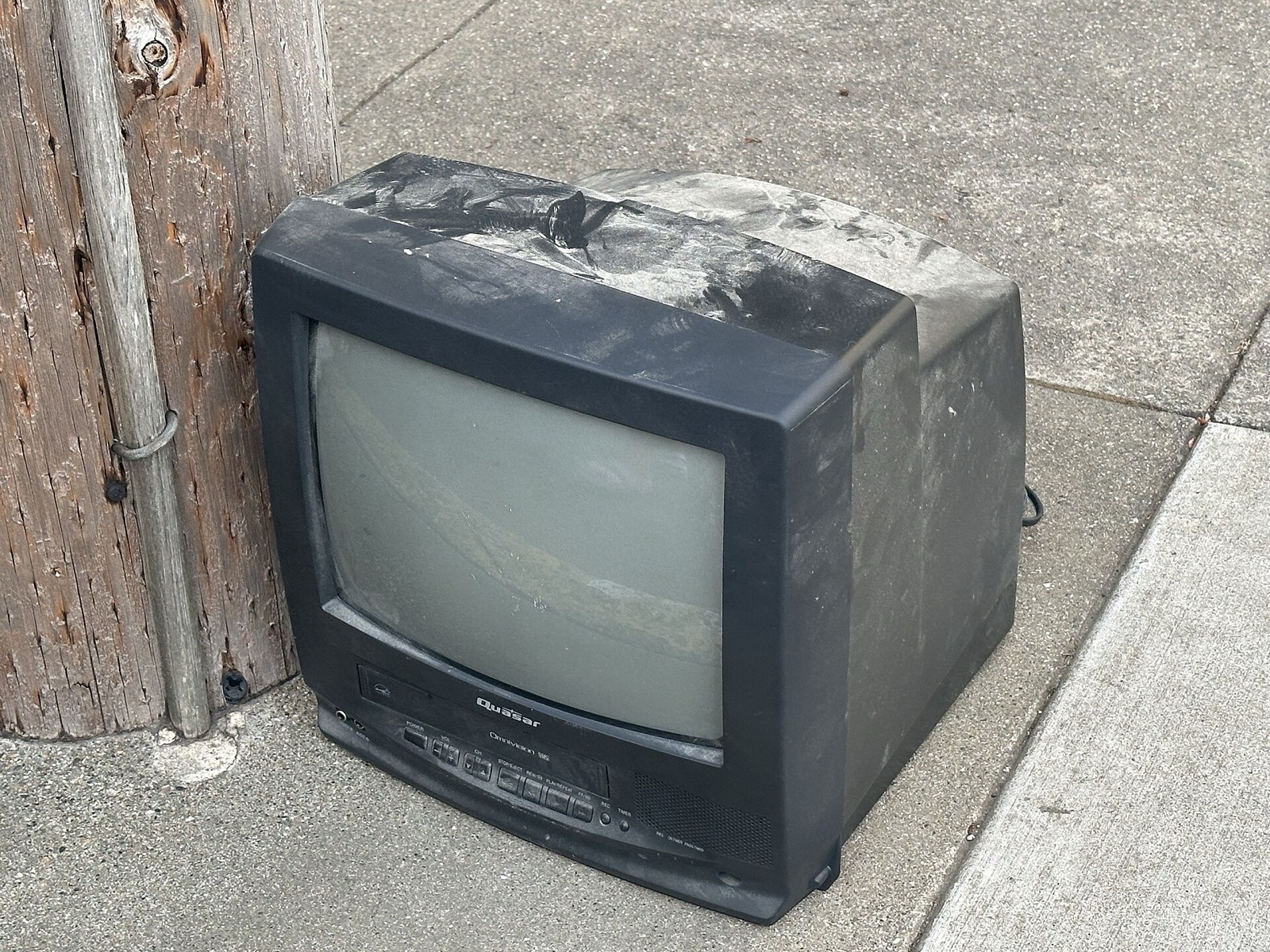
A tube (CRT) TV holds lead in its glass. The Iowa Department of Natural Resources says each CRT contains 5 to 7 pounds of lead. The U.S. EPA says the lead is in the funnel glass, the cone-shaped back part of the tube.
Don’t smash a tube TV to make it smaller or to pull out metal. Broken glass with lead is harder and more dangerous for anyone to handle. Keep the TV upright and in one piece.
Flat screens need care too. Florida DEP notes mercury in flat-panel backlights. Don’t take a flat screen apart either.

Get the TV ready before it leaves your home
- Sign out of streaming apps, then factory reset a smart TV from its settings menu.
- Take the batteries out of the remote. The EPA says to remove batteries before you recycle electronics, because some need separate recycling.
- Unplug the TV and coil the power cord. Keep the remote and stand with it if you’re selling or donating.
- Take a wall-mounted TV down with two people, following the mount’s instructions. Lay it on a blanket, not on its edge.
- If the screen is cracked, wrap it in plastic or a blanket and tape it. Call the site first, because some won’t take a broken TV.
- Carry a tube TV with two people, because tube TVs are heavy.
- Measure the screen corner to corner. Best Buy and many city sites set size limits.
How to find the rules where you live
- Check your state’s law. Our state-by-state guide shows whether TVs are banned from the trash and whether your state has a TV recycling program.
- Look up your city or county. Search your city or county name with "electronics recycling" or "TV disposal", and use the official .gov page.
- Open our city guide if we cover your city. Each one lists drop-off sites, fees, limits and the local rules, with sources.
- Call the site before you drive. Ask if it takes your TV type and size, what it costs, and what ID to bring.
Checklist
- Plug the TV in to see if it still works before you decide where it goes.
- Check whether your state bans TVs from the trash.
- Find your city or county drop-off site and its fee, hours and limits.
- Measure the screen and note whether it’s a tube or flat-screen TV.
- Sign out of your accounts and factory reset a smart TV.
- Wrap a cracked screen, and never break open a tube TV.
- Call ahead, and bring proof that you live there.
Common questions
What is the cheapest way to get rid of an old TV?
Giving away or selling a working TV costs nothing. For a broken TV, a state program site or your city or county drop-off site is often free for residents. Best Buy charges $29.99 per TV in most states.
Can I put an old TV out with my trash?
It depends on your state and city. 15 states and Washington, D.C. ban TVs from the trash, and many cities refuse TVs at the curb even where the state allows it. Check your state and city rules first.
Does Best Buy take old TVs?
Yes. Best Buy takes flat screens 50 inches and under and tube TVs 31 inches and under. It costs $29.99 per TV in most states and is free in California, Connecticut and Hawaii. The limit is 2 TVs per household per day.
Will Goodwill take my old TV?
Call your local store first. Florida DEP says many second-hand stores, such as Goodwill and the Salvation Army, no longer accept tube (CRT) TVs. Ask the store about flat screens.
How do I get rid of a TV that’s too big for Best Buy?
Best Buy won’t take flat screens over 50 inches or tube TVs over 31 inches in store. Take it to your city or county drop-off site, which often has no size limit, or book a pickup.
Is it illegal to dump a TV?
Leaving a TV on the curb or in an empty lot can count as illegal dumping or littering. In Sioux Falls, leaving items outside the closed drop-off site can cost up to $200. Dallas can bill you for TVs left in a bulky pile.
Should I smash a tube TV before I throw it out?
No. Tube TVs hold 5 to 7 pounds of lead, according to the Iowa DNR. Breaking the glass makes the TV harder and more dangerous to handle. Keep it whole and take it to a site that takes tube TVs.
Sources
Checked November 24, 2026. Your local drop-off site’s rules come first.
Best Buy - Electronics and Appliances Recycling ↗U.S. EPA - Electronics Donation and Recycling ↗U.S. EPA - Cathode Ray Tubes (CRTs) ↗Iowa DNR - Cathode Ray Tubes fact sheet ↗Florida DEP - Electronics Waste ↗TCEQ - Texas Recycles TVs Program (Find a TV Recycler) ↗Samsung - Recycling programs (U.S.) ↗NYSDEC - Recycling Consumer Electronic Waste ↗Washington Department of Ecology - E-Cycle Washington ↗Oregon DEQ - Disposal ban on computers, monitors and TVs ↗Vermont E-Cycles ↗DSNY - Special Waste Drop-Off ↗NYC 311 - Electronics disposal ↗DSNY - Electronics and E-Waste ↗City of Dallas Sanitation - Brush and Bulky Item Collection ↗City of Sioux Falls - Electronics Recycling ↗City of Boston - Special collection items ↗City of Phoenix - Appliance Recycling (TVs and CRTs) ↗City of Sioux Falls - Household Hazardous Waste Facility ↗E-Cycle Washington - Program details ↗How we research →