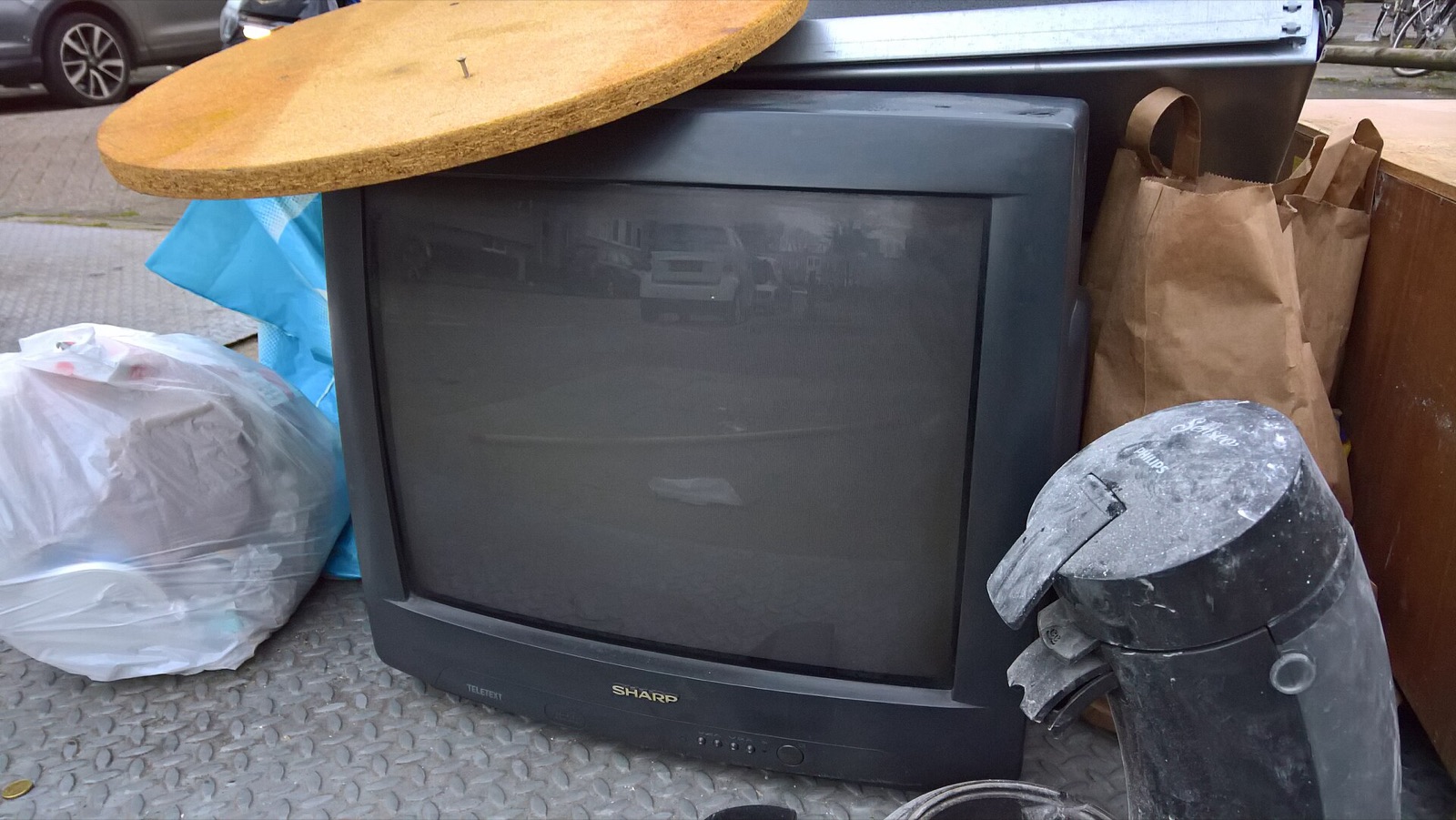

In 15 states and Washington, D.C., you can’t put a TV in the trash. Maine, Massachusetts and Minnesota ban tube (CRT) TVs. Elsewhere, state law often allows it, but many cities and landfills still refuse TVs. Recycling keeps the lead and other metals in TVs out of landfills. Check your city’s rule before you set a TV out.
The short version
- 15 states and Washington, D.C. ban TVs from the trash.
- Maine, Massachusetts and Minnesota ban tube (CRT) TVs from the trash. Massachusetts also bans most flat-panel TVs, under its mercury rule.
- In 18 states, the state allows TVs in the trash or has no ban.
- In the other 14 states we couldn’t find a clear statewide answer.
- In every state, your city, county or landfill can be stricter than state law.
| Rule | States |
|---|---|
| TVs banned from the trash (15 states and D.C.) | California, Colorado, Connecticut, District of Columbia, Illinois, Indiana, New Hampshire, New Jersey, New York, North Carolina, Oregon, Pennsylvania, Rhode Island, South Carolina, Vermont, Wisconsin |
| Tube TVs banned (3 states) | Maine, Massachusetts, Minnesota |
| No statewide ban (18 states) | Alabama, Alaska, Arkansas, Florida, Kentucky, Maryland, Michigan, Missouri, Montana, Nebraska, Nevada, Ohio, Texas, Utah, Virginia, Washington, West Virginia, Wyoming |
| Not clear statewide (14 states) | Arizona, Delaware, Georgia, Hawaii, Idaho, Iowa, Kansas, Louisiana, Mississippi, New Mexico, North Dakota, Oklahoma, South Dakota, Tennessee |
Can you throw away a TV? Every state
"Yes, banned" means TVs can’t go in the trash or a landfill. A state law or the state environment agency says so. "No statewide ban" means the state allows it or has no ban; local rules may still forbid it. "Not clear statewide" means we found no state law or agency page that settles it either way. Some of these states ban only tube TVs, or only for businesses.
"State recycling program" means the state runs, or makes TV makers fund, a recycling program for residents. It doesn’t always mean drop-off is free.
| State | TVs banned from the trash? | State recycling program? | Notes |
|---|---|---|---|
| Alabama | No statewide ban | No | The state environment agency (ADEM) says a city landfill is an acceptable place for old electronics, but urges reuse and recycling. |
| Alaska | No statewide ban | No | The state says e-waste is handled many ways, including landfill. Anchorage won’t take TVs in curbside collection. |
| Arizona | Not clear statewide | No | We found no state law either way and couldn’t read the state agency’s pages. A 2026 bill (SB 1357) isn’t law. |
| Arkansas | No statewide ban | No | State law lets the state environment agency ban electronics from landfills, but the agency hasn’t done it. Local landfills may set limits. |
| California | Yes, banned | Yes | CalRecycle lists TVs as banned from the trash. A $4 to $6 fee when you buy a TV pays for recycling. |
| Colorado | Yes, banned | No | Landfill ban since July 1, 2013. No funded program, so expect a recycling fee. |
| Connecticut | Yes, banned | Yes | Banned from solid waste sites since 2011. Each town must give residents free collection, 7 or fewer devices at a time. |
| Delaware | Not clear statewide | Yes | No ban found. The Delaware Solid Waste Authority takes TVs free from residents at 4 drop-off sites. It also holds collection events. |
| District of Columbia | Yes, banned | Yes | Banned since 2018. No maker group held eCYCLE events in 2025, so use DPW collection events or makers’ mail-back programs. |
| Florida | No statewide ban | No | No specific state rules for discarded electronics. The state strongly recommends recycling. Some recyclers no longer take tube TVs. |
| Georgia | Not clear statewide | No | We found no state law either way, and the state’s page doesn’t mention TVs. Ask your city or county. |
| Hawaii | Not clear statewide | Yes | Makers fund free central drop-off for TVs 9 inches and up. Honolulu still lets you put TVs out with household trash. |
| Idaho | Not clear statewide | No | We found no law either way. Many county landfills collect electronics separately, so call your county. |
| Illinois | Yes, banned | Yes | Banned from landfills, households included. Program sites may charge fees only for TVs and monitors. |
| Indiana | Yes, banned | Yes | Households can’t throw TVs away since January 1, 2011. Makers must recycle 60% by weight of what they sell. |
| Iowa | Not clear statewide | No | Businesses can’t landfill tube TVs. The state calls tube TVs a household hazardous material and says to recycle them. |
| Kansas | Not clear statewide | No | We found no law either way and couldn’t read the state agency’s site. Sedgwick County points to paid recyclers and events. |
| Kentucky | No statewide ban | No | Household electronics aren’t banned. They can go in the garbage if your collector and landfill accept them. |
| Louisiana | Not clear statewide | No | We found no law either way. The state environment agency urges you not to throw TVs away. |
| Maine | Not clear statewide | Yes | Tube TVs are banned from landfills; the law doesn’t name flat screens. Towns choose whether to join the maker-funded program. |
| Maryland | No statewide ban | No | Makers register and pay a fee but don’t have to run take-back. No statewide trash ban found. |
| Massachusetts | Not clear statewide | No | Tube TVs banned since 2000. A mercury rule covers most flat-panel TVs too. Your city sets the cost of recycling. |
| Michigan | No statewide ban | Yes | Makers must offer free take-back of TVs and other covered devices. No statewide trash ban found. |
| Minnesota | Not clear statewide | Yes | Tube TVs banned from the trash since 2006; the law doesn’t mention flat screens. Drop-off isn’t always free. |
| Mississippi | Not clear statewide | No | We found no law either way. There’s no household TV recycling program. |
| Missouri | No statewide ban | No | The state says most electronics from homes can legally go out with the trash. Businesses can’t send certain electronics to landfills. |
| Montana | No statewide ban | No | The state says no law bans electronics from landfills or requires recycling. |
| Nebraska | No statewide ban | No | The state says household TVs can legally go to a local landfill. Recycling is encouraged, not required. |
| Nevada | No statewide ban | No | State law lists e-waste as recyclable but doesn’t ban it from landfills. The state recommends certified recyclers. |
| New Hampshire | Yes, banned | No | State law bans electronics, TVs included, from landfills and incinerators. Towns and stores set their own fees. |
| New Jersey | Yes, banned | Yes | Banned from the garbage. Sites in a maker’s approved plan can’t charge you. |
| New Mexico | Not clear statewide | No | We found no law either way. The state recommends e-Stewards or R2 certified recyclers. |
| New York | Yes, banned | Yes | Banned since January 1, 2015. Sites in a maker’s program can’t charge most consumers. |
| North Carolina | Yes, banned | Yes | Banned from landfills since 2011. TV makers pay into the program, but the law doesn’t make TV drop-off free. |
| North Dakota | Not clear statewide | No | We found no law either way. Some landfills, like Fargo’s, don’t take electronics. |
| Ohio | No statewide ban | No | No statewide ban and no state program. Most local recyclers and stores charge for TVs. |
| Oklahoma | Not clear statewide | No | The state computer recycling law leaves out TVs. We found no state rule on TVs in the trash. |
| Oregon | Yes, banned | Yes | Banned since 2010, and you can be fined. Oregon E-Cycles takes 7 or fewer items free from anyone. |
| Pennsylvania | Yes, banned | Yes | No TVs in household trash since 2013. Maker programs must be free or give a rebate worth at least as much. |
| Rhode Island | Yes, banned | Yes | Banned since 2009 for screens over 9 inches. The state’s resource recovery agency recycles TVs free for households. |
| South Carolina | Yes, banned | Yes | You can’t knowingly put a TV in trash bound for a landfill. Every county has sites or events; the state doesn’t say they’re free. |
| South Dakota | Not clear statewide | No | Household electronics aren’t regulated as hazardous waste. Sioux Falls bans electronics from its landfill by ordinance. |
| Tennessee | Not clear statewide | No | We found no state law either way. Nashville bans electronic waste from trash containers. |
| Texas | No statewide ban | Yes | The state says household electronics can go in your trash. Each TV maker must offer recycling with no separate fee. |
| Utah | No statewide ban | No | Makers must list recycling options, not fund collection. No statewide ban found. |
| Vermont | Yes, banned | Yes | Banned from landfills since 2011. Vermont E-Cycles takes TVs free from households. |
| Virginia | No statewide ban | No | The state’s computer recycling law leaves out TVs. No landfill ban found. |
| Washington | No statewide ban | Yes | E-Cycle Washington is free, up to 10 items. No statewide ban, but Seattle bars tube TVs from the garbage. |
| West Virginia | No statewide ban | No | The old landfill ban was repealed (HB 4540), and landfills may charge. Berkeley County kept its own ban. |
| Wisconsin | Yes, banned | Yes | Banned from trash, landfills and incinerators since 2010. E-Cycle Wisconsin fees vary by site. |
| Wyoming | No statewide ban | No | The state said in 2020 that e-waste is legal to put in landfills. It asks you to recycle where you can. |
What "Not clear statewide" means
There are 17 "Not clear statewide" entries, including the 3 tube-TV-only states. For these, we couldn’t find a state law or agency page that clearly allows or bans TVs in household trash. Sometimes the law covers only tube TVs, as in Maine and Minnesota. Sometimes it covers only businesses, as in Iowa and South Dakota. In some states we found no rule at all, or couldn’t read the agency’s website.
"Not clear statewide" is not a green light. In those states, the answer comes from your city, county or landfill. Nashville and Sioux Falls are both in "not clear" states, and both ban TVs from the trash locally.
Your city can be stricter than your state
State law sets the floor. Cities, counties and landfill operators can refuse TVs even where the state allows them in the trash. These examples come from our city guides:
- Nashville, Tennessee: Metro Code 10.20.095 keeps electronic waste out of trash containers. Residents can drop off one TV per visit free at three convenience centers.
- Sioux Falls, South Dakota: a city ordinance has banned electronics from the regional landfill since May 4, 2004. The city takes TVs free at its Household Hazardous Waste Facility.
- Seattle, Washington: Washington has no statewide ban. But King County says Seattle doesn’t accept tube TVs in home or business garbage.
- Dallas and Houston, Texas: Texas allows TVs in the trash, but neither city’s bulky trash pickup takes them. Dallas can bill you $60 per 5 cubic yards if your pile has items it doesn’t take, such as TVs.
- Fargo, North Dakota: the city’s landfill permit bars electronics. The city’s Household Hazardous Waste Facility takes TVs instead.
- Anchorage, Alaska: curbside collection won’t take TVs. Residents may still put one TV a day in a residential trash load at regular disposal rates.
Why tube TVs are treated differently
Old tube (CRT) TVs hold lead in their glass. The Iowa Department of Natural Resources says each CRT contains 5 to 7 pounds of lead. The U.S. EPA says the lead sits in the funnel glass, the cone-shaped back of the tube. That’s why discarded CRTs can count as hazardous waste under federal rules.
Households are often exempt from those hazardous waste rules. Alabama and Alaska both say so. That’s why some states let you throw away a tube TV from home but don’t let businesses do it. Iowa bars businesses from landfilling tube TVs, and South Dakota makes businesses handle them as hazardous waste.
Maine, Minnesota and Massachusetts ban tube TVs even from household trash. That’s on top of the states that ban all TVs. Flat screens carry risks too. Florida DEP notes mercury in flat-panel backlights, and MassDEP’s mercury rule covers most flat-panel TVs.

What to do instead of throwing a TV away
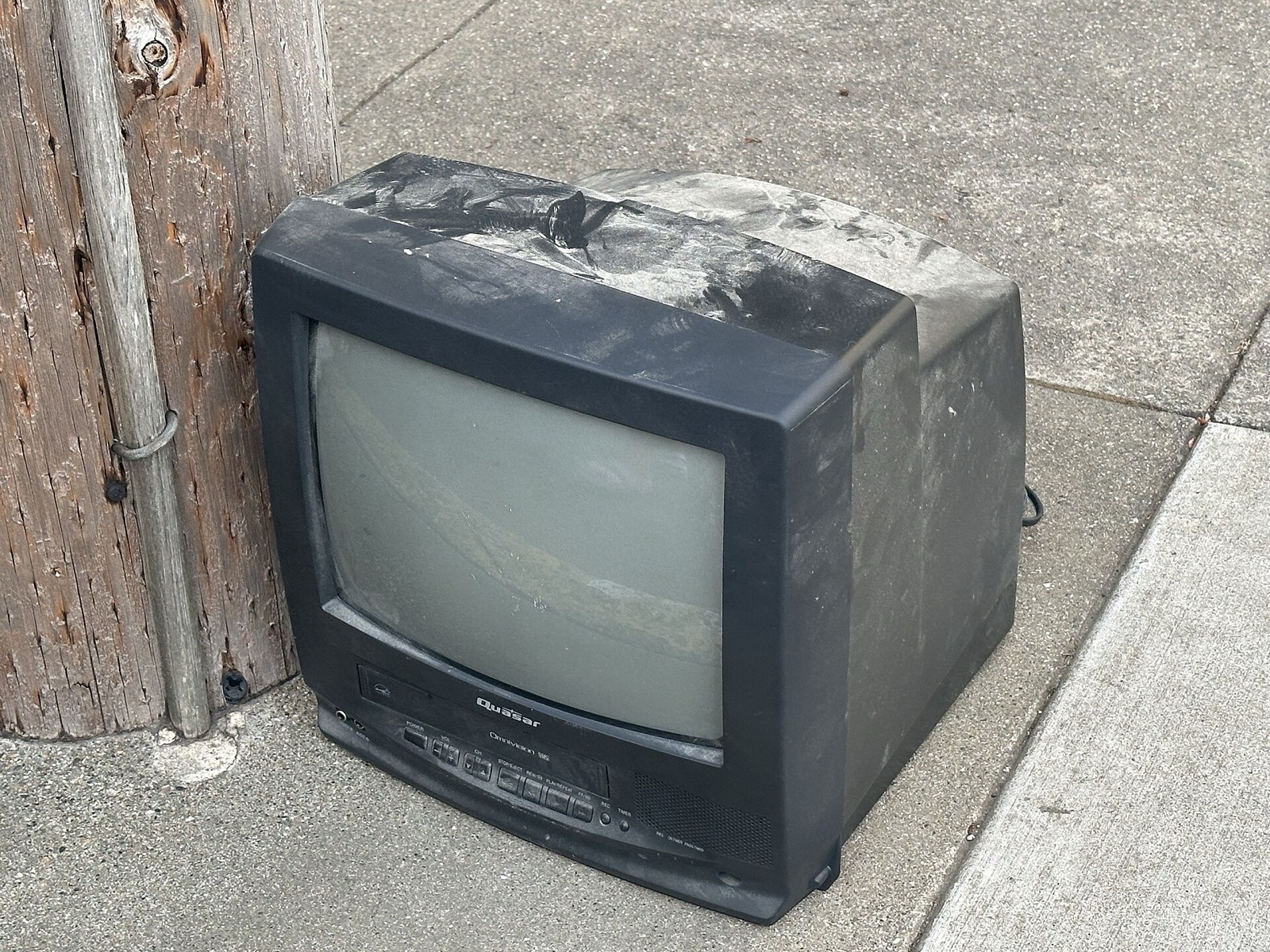
- If it works, sell it or give it away. Call a charity first, because many don’t take tube TVs.
- Look for a free state program site if your state has one. Examples are E-Cycle Washington, Oregon E-Cycles and Vermont E-Cycles.
- Use your city or county drop-off site. Bring proof that you live there.
- Take it to Best Buy. Stores take flat screens 50 inches and under and tube TVs 31 inches and under. It costs $29.99 per TV in most states, and is free in California, Connecticut and Hawaii.
- If you can’t move it, book a city bulk pickup that takes TVs, or a paid pickup.
Checklist
- Find your state in the table above.
- Check your city or county’s trash rules, even if your state allows TVs in the trash.
- Don’t put a TV in your cart or at the curb unless your city says you can.
- Keep tube TVs whole; don’t break the glass.
- Find a drop-off site near you, and call ahead about fees and limits.
Common questions
Is it illegal to throw a TV in the garbage?
In 15 states and Washington, D.C., yes. Maine, Massachusetts and Minnesota also ban tube TVs. In other states it may be legal under state law, but your city or landfill may still refuse it.
Can I put a flat-screen TV in the trash?
Not in the 15 states and D.C. that ban all TVs. Massachusetts also bans most flat-panel TVs because of mercury. Elsewhere, check your city’s rules.
Can you throw a TV in the trash in Texas?
Texas state law allows it, and TCEQ says household electronics can go in your trash. But Dallas and Houston bulky pickups won’t take TVs. Each TV maker must offer a recycling option with no separate fee.
Can you throw a TV in the trash in Florida?
Florida has no specific state rules for discarded electronics. The Florida DEP strongly recommends recycling TVs. Check your county’s rules before you set one out.
What happens if I leave a TV at the curb?
It depends on your city. Many crews won’t take it, and you may be billed or cited. Dallas can bill $60 per 5 cubic yards for a bulky pile with items it doesn’t take. Oregon can fine you for knowingly throwing a TV away.
Why can’t TVs go in landfills?
TVs contain metals that can harm the environment. Tube TVs hold 5 to 7 pounds of lead each, according to the Iowa DNR. Many flat panels have mercury in their backlights.
Can I throw away a TV if it’s broken?
The same rules apply to broken and working TVs. A broken TV can still go to a recycling drop-off. Wrap a cracked screen, and call first, because some sites won’t take damaged TVs.
Sources
Checked November 24, 2026. Your local drop-off site’s rules come first.
Alabama: ADEM: Household Wastes - Management of CRTs and other electronic devices (May 2018, PDF) ↗Alaska: Alaska DEC - Hazardous Waste Regulations Questions and Answers (e-waste, updated 10/25/2023, PDF) ↗Arizona: Arizona Legislature - SB 1357 (2026), large electronics; recycling; programs (introduced) ↗Arkansas: Arkansas DEQ - Electronics Reuse and Recycling ↗California: CalRecycle - Waste Banned from the Trash ↗Colorado: CDPHE: Information on residential electronics and computer waste ↗Connecticut: CT DEEP - CT Electronic Recycling Law FAQs ↗Delaware: Delaware Code Title 7, Chapter 64, Subchapter I (§ 6403, Delaware Solid Waste Authority) ↗Delaware: DSWA - Electronic Goods Recycling ↗District of Columbia: DOEE - eCYCLE DC Disposal Ban flyer ↗District of Columbia: DOEE - eCYCLE DC ↗Florida: Florida DEP - Electronics Waste ↗Georgia: Georgia EPD - Recycling and Waste Reduction Resources ↗Hawaii: Hawaii DOH - Electronic Device Recycling and Recovery Law ↗Hawaii: HRS Chapter 339D, Electronic Device Recycling and Recovery Law (PDF) ↗Idaho: Idaho DEQ - Residential household wastes ↗Illinois: Illinois EPA: Electronics Recycling FAQs ↗Indiana: IDEM - Indiana regulations affecting electronic waste (e-waste) ↗Indiana: IDEM - Indiana E-Cycle ↗Iowa: Iowa DNR - Appliances and Electronics ↗Kansas: Sedgwick County - Recycling Guide ↗Kentucky: Kentucky Energy and Environment Cabinet: E-scrap laws ↗Louisiana: LDEQ: Recycling Resources and Recyclers ↗Maine: 38 M.R.S. § 1306 (cathode ray tube disposal ban, subsection 4) ↗Maryland: MDE - eCycling (Maryland electronics recycling) ↗Massachusetts: MassDEP - Waste Disposal Bans ↗Massachusetts: 310 CMR 19.017 (CRT ban since April 1, 2000) ↗Michigan: Michigan EGLE - FAQ: Michigan electronics takeback program ↗Minnesota: Minnesota Statutes 115A.9565: Prohibition on CRTs in mixed municipal solid waste ↗Mississippi: MDEQ - Electronic Waste ↗Missouri: Missouri DNR - E-cycle Missouri ↗Montana: Montana DEQ - Recycling Resources (Electronics) ↗Nebraska: Nebraska DWEE (formerly NDEE) - Guidance 09-004: Waste Computers, Monitors, and Electronics (rev. Feb. 2021) ↗Nevada: Nevada Revised Statutes Chapter 444A ↗New Hampshire: N.H. RSA 149-M:27 (disposal prohibited) ↗New Jersey: NJDEP - E-Waste Frequently Asked Questions (Jan. 18, 2024) ↗New Mexico: NMED - Diverting from Landfills: Recycling and Composting (electronic scrap) ↗New York: NY Environmental Conservation Law 27-2611 (disposal ban) ↗North Carolina: NC DEQ: Electronics Management ↗North Dakota: North Dakota DEQ - Electronics Recycling ↗Ohio: Ohio EPA - Handling Household Hazardous Waste (April 2015), Electronic Equipment section ↗Oklahoma: Oklahoma DEQ - Oklahoma Computer Equipment Recovery Act (OCERA) ↗Oregon: Oregon DEQ - Disposal ban on computers, monitors and TVs ↗Pennsylvania: PA DEP - Covered Device Recycling Act FAQs (PDF) ↗Rhode Island: R.I. Gen. Laws § 23-24.10-5 (disposal ban) ↗South Carolina: SC DES: Electronics Recycling: Residents ↗South Dakota: SD DANR - Electronic Waste Management: A Guide for Businesses in South Dakota (May 2021) ↗Tennessee: TDEC - Household Batteries, Oil, Paint, Antifreeze, and Electronics (BOPAE): Household Electronics, E-scrap Households and Individuals, R2 Certified Recyclers ↗Texas: TCEQ: Texas Recycles TVs Program ↗Texas: TCEQ - E-recycling regulations (household electronics in the trash) ↗Texas: TCEQ - TV recycling program manufacturer guidance (no separate fee) ↗Utah: Utah Code Title 19, Chapter 6, Part 12 - Disposal of Electronic Waste Program (PDF) ↗Vermont: 10 V.S.A. § 6621a (landfill disposal ban) ↗Virginia: Code of Virginia - Computer Recovery and Recycling Act (Title 10.1, Chapter 14, Article 3.6) ↗Washington: Washington Department of Ecology - E-Cycle Washington ↗West Virginia: WVDEP - Covered Electronic Devices Again Being Accepted at West Virginia Landfills ↗Wisconsin: Wisconsin Legislature - Wis. Stat. 287.07 (landfill and incinerator bans) ↗Wyoming: Wyoming DEQ - DEQ supports recycling of electronic waste (March 20, 2020) ↗U.S. EPA - Cathode Ray Tubes (CRTs) ↗Iowa DNR - Cathode Ray Tubes fact sheet ↗MassDEP - FAQ on the mercury-added product disposal ban ↗Metro Nashville Waste Services - Electronic Waste Recycling ↗City of Sioux Falls - Electronics Recycling flyer (2004 landfill ban) ↗City of Sioux Falls - Electronics Recycling ↗City of Dallas Sanitation - Brush and Bulky Item Collection ↗King County - Electronics recycling (Seattle garbage rule) ↗City of Houston - Electronics & Recycling ↗City of Fargo - Landfill Rules ↗City of Fargo - Electronics Recycling ↗Anchorage SWS - How Do I Dispose Of... (televisions) ↗Honolulu ENV - E-waste Recycling ↗City of Cleveland - Waste and Recycling Guide 2026 ↗Best Buy - Electronics and Appliances Recycling ↗How we research →